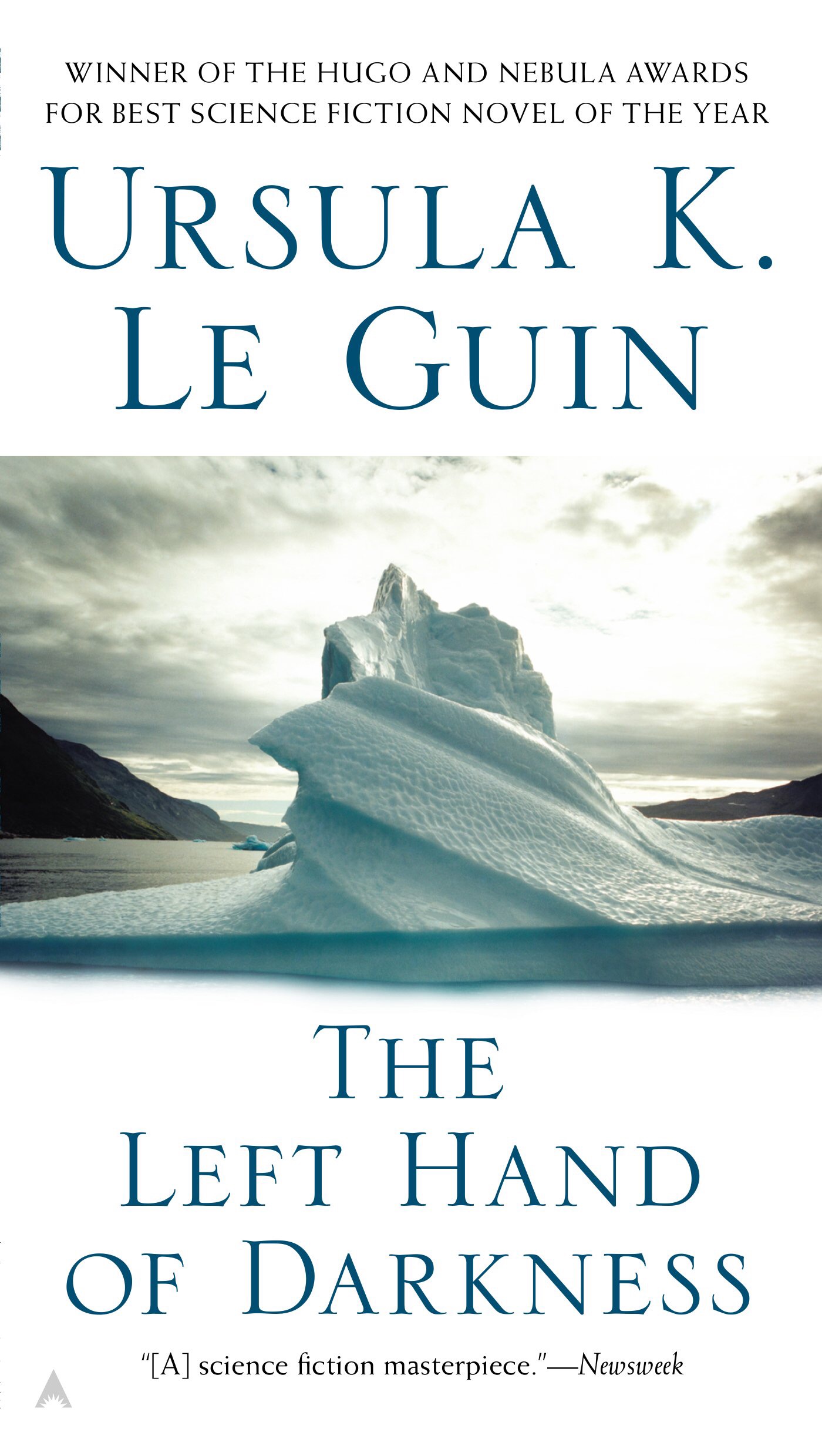
The Left Hand of Darkness by Ursula Le Guin


“A profound love between two people involves, after all, the power and chance of doing profound hurt.”

This was recommended to me due to how much I like Margaret Atwood, which meant I went in with high expectations. Unfortunately, it just felt too dry to be to my taste in science fiction. I don’t think it’s a bad book, and I’m glad I read it as I can’t remember anything else quite like it. I just never became truly invested in what was happening.On a frozen planet of sexless androgynists, an envoy from another world arrives offering them membership in an interstellar partnership. In the wrong hands a premise like this could come across as a wacky “Planet of Hats” (re:TvTrope) attempt at hamfisted political exploration, but Le Guin has an impressive take on the actual ramifications of a society like this.

While The Left Hand of Darkness raises a number of interesting issues, I never grew all that invested in the story. The only part which I don’t think will meld together in my mind into a long description of dry conversations in cold rooms is an exciting expedition over a country-long stretch of ice.

The prose was at times thoughtful and measured, but everything moves along at a weird pace. The diary format results in the description of events like an attack on a farm lacking tension, which works in some moments as there is a lot of stuff to take in, and this allows for enormous exposition dumps without feeling too forced. But I only ever grew attached to one character, Estraven, and during the rest of the novel I felt like I was watching a slow-paced documentary. The subjects were interesting, and there were some intelligent observations made, but everything felt detached. I’d recommend it to people who are more interested in world-building than I am, though.

Cloud Atlas by David Mitchell

“One fine day, a purely predatory world shall consume itself. Yes, the devil shall take the hindmost until the foremost is the hindmost. In an individual, selfishness uglifies the soul. For the human species, selfishness is extinction. […] Is this the doom written within our nature?”

Near the beginning of Cloud Atlas, taking place around one-hundred and fifty years ago, a priest recounts how pacifist ‘savages’ were slaughtered by nearby Maori tribes. “What moral to draw?” our first narrator, a white American gentleman, muses. “Peace […] is a cardinal virtue only if your neighbours share your conscience.”

This is a novel split into six: six sections, six protagonists, six time periods, six genres. 19th century New Zealand among tribes who are being colonised; pre-World War 2 Belgium; California in the midst of the 70s counter-culture; North-East provincial England; a dystopic Korea in the 22nd century (I think) where capitalism has been taken to alarming extremes; back to tribalism in a far flung future. The stories stop in their middle, only to start again after you have seen how the future has been influenced by these tales: in some cases this was significantly, in others not.

This might seem like a gimmick, which is something the novel is conscious of. It wants you to know you’ll be rewarded if you stick with it, that any efforts to pay close attention will not be brushed aside in some sort of irritating postmodern game, such as in Italo Calvino’s ‘If on a winter’s night a traveller‘ (which I found infurating). Little self-conscious prods mid-way through keep the reader assured that Mitchell will not leave threads untied, such as when Robert Frobisher, a young, selfish and gifted composer, muses about his new work:

“In the first set, each solo is interrupted by its successor; in the second, each interruption is recontinued, in order. Revolutionary or gimmicky? Shan’t know until it’s finished, and by then it’ll be too late.”

Mitchell slips in and out of different characters and situations with astonishing ease, and what should feel—due to its scattered narratives and sheet ambition—cluttered, confusing and unfocused is held together by very wonderful but careful writing, and themes which emphasize humanity’s interconnected nature. Symbols, plot-points and characters occasionally connect the six stories, but these threads are never overemphasized to make a narrative point or to seem clever. In other words, they stay fun to spot. Each story shows someone trying to overcome oppression, but you could read each of them in isolation and still enjoy them.

At its core, Cloud Atlas is occupied with humanity’s history of violence and opression, and where that history may lead us. That’s why it stays interesting despite being so ridiculously busy in terms of story. In each of the sections, arrogance, entitlement and greed mean that characters are unfairly treated and hurt. I expected something optimistic here, as I had watched the Wachowski’s film version, which changes some of the endings (most notably the tribal future’s) so they’re more uplifting. I think the novel is more honest about where our current course could take us if we aren’t very, very careful, and as such is a more honest plea for empathy.

Many novels this ambitious falter because, in the search of grand philosophical themes and strange structures, they forget character and storytelling. Cloud Atlas, thanks in part to its beautifully crafted first-person style (except in California, where it becomes an intruiging third-person thriller) feels extremely personal, and so succeeds where most other books of this sort would fail.
The Brothers Karamazov by Fyodor Dostoevsky

This is a great book. That’s a generic thing to say, but in sincerity, in depth, in ambition, and in intelligence very little else I’ve read comes close to The Brothers Karamazov. This is a novel with that strange, intangible quality that makes you put it down occasionally, stare into space, and say ‘wow’.

Fierce is a good word for this novel. It’s also often funny, but you always take the characters seriously. There’s absurdity, but just enough to keep things entertaining without being ridiculous and never so much that you’re pulled out of the narrative. It’s like a friendly but drunk man is confessing his difficult life story: he might occasionally slur some words, and he makes you laugh at times, but you can tell that he feels every word is important. 

There are so many disparate elements floating around for the first four-hundred pages that it was difficult to imagine how they could ever coalesce, and there are slow moments even further on in the book. But everything, by the end, was tied together. Moments that could come across as saccharine are tinged with significance, as there’s such a strong moral centre that you buy them, sentimentality and all. The extreme natures of the characters are revealed as expressing the horrific depths that emotion can plunge us into. Their intensity reveals the consequences of suffering in daily life, and the difficulty in being good.

This is all also very entertaining to read about which is a hard thing to pull off, especially in a book this long. This thing is just fun. Imagine a soap written by one of the smartest people who ever lived and you’ve got the idea.

The Karamazov brothers are three of the most acutely drawn characters in existence, particularly Ivan, who is the crux of two of the best chapters — ‘The Grand Inquisitor’ and ‘The Devil’. But it’s hard not to love Alyosha, who is almost absurdly sensitive, but also clever, trusting, and wise. Dmitry is incredibly intense in every aspect, but honest and with a strange sense of honour that’s engaging to read about.

Ilyusha’s introduction in Book X, where Alyosha meets a group of schoolchildren who are throwing rocks at a classmate, was, however, the moment when I realised this was going to be a book I’ll be happy to revisit in the future.

I know I’ll get something new out of it every time I pick it up again, wherever I am in my life.

Notes from Underground by Fyodor Dostoevsky

“I could not become anything; neither good nor bad; neither a scoundrel nor an honest man; neither a hero nor an insect. And now I am eking out my days in my corner, taunting myself with the bitter and entirely useless consolation that an intelligent man cannot seriously become anything, that only a fool can become something.”

Occasionally funny, often disgusting, the novel Notes from Underground is the mournful wail of a man who has given up and is proud of it, a man who thinks you’re foolish for not succumbing to nihilism like he has. This is one of the most bitter, angry novels I’ve ever read. I’d heard the stereotype of Russian literature as depressing, but The Brothers Karamazov, Pushkin, or Tolstoy all seem absolutely joyful in comparison. I thought that almost two centuries later, the barrage of misery the protagonist endures and self-inflicts here might seem tame to a modern reader. Nope. This is still very, very powerful.

The narrator’s pain being almost entirely self-inflicted is a dominant theme. He was a bureaucrat, but an inheritance allowed him to retire. He does nothing but brood on those he perceived as wronging him. The results are both sad and funny, in a way that becomes so obviously self-inflicted that it feels like a farce. It takes the narrator dozens of attempts to bump a man of higher standing’s shoulder on his morning walk to work, for example. He has been plotting this bump as an act of revenge for years. The man’s crime? A long, long time ago he had ignored our protagonist at a pub. Shocking, I know.

The narrator has lived his whole life on a self-destructive path which is narcissistic and cowardly, but, thanks to his eloquent way of writing, understandable. He is a pitiful, self-disgusted man. He has isolated himself from the world, and lives in a cocoon of anger; he derides a society he sees as arrogant and foolish, but acts no better—worse, in fact—than those he considers scum. The only thing he has pride in is his intellect, the importance of which he clings to like a limpet. He only values what is inside his head, and rages at the world around him which he sees as ignoring his genius. The futility of pride in intelligence, which he uses for nothing but selfish brooding, becomes obvious to readers, as it helps no one, not even him.

Notes From Underground is dark, sad and quite moving. If you’re ever in the mood for a book which stomps on your brain and heart, give it a go.

On Writing by Stephen King

“So okay― there you are in your room with the shade down and the door shut and the plug pulled out of the base of the telephone. You’ve blown up your TV and committed yourself to a thousand words a day, come hell or high water. Now comes the big question: What are you going to write about? And the equally big answer: Anything you damn well want.”

Books on writing often start with the strange assumption that the reader is already wonderfully disciplined, and merely needs guidance in regards to adjectives and paragraph structure. King is more helpful. He explains the nuts and bolts of his trade rather than the just the tweaks needed to finished products. He takes the time to dispel myths about the magic of ‘inspiration’ as the cause of good stories, and encourages you to approach the craft in the way of a carpenter: it can be difficult, yes, but once you’ve learned the tools of the trade the most useful thing you can do is sit at your desk every morning.

King’s books do not crave being taken seriously, they merely hope that they are. They embrace some ridiculous premises, and are happy to sit on genre shelves while their creator bathes in money, but if you approach them with trust they are often refreshingly honest portraits of very strange situations. This makes him the perfect person to explain the actual process of fiction writing, as he avoids romantic ruminations which impede serious discussion of what should be, above all else, hard work.

King is above all practical, but also infectiously enthusiastic. His love for the craft shines through, and his focus on the joy of his job makes you able to take him more seriously when he talk about the difficulties.

The Pale King: An Unfinished Novel by David Foster Wallace

“How odd I can have all this inside me and to you it’s just words.”

This is an incomplete novel by David Foster Wallace that was released posthumously. It’s sometimes dazzling and other times tedious. I would never, ever recommend it to anyone but a hardcore David Foster Wallace fan. It’s in such a specific style, and tries to make you feel the banality that its characters live and grow in, which makes for an interesting experiment which is occasionally (intentionally) mind-numbing to read. Like with all of DFW’s works, though, the words are put together with tremendous skill, and can crackle in your skull and leave you thinking days after you put the book down.

“To be, in a word, unborable…. It is the key to modern life. If you are immune to boredom, there is literally nothing you cannot accomplish.”

The Pale King takes place in the IRS (the Internal Revenue Service) and I appreciated that aspects of life which are often ignored — taxes, social malaise, the difficulty of true acceptance — are put under the microscope, as seemingly unrelated events slide in and out of view at random. The fragmented chapters leave you disorientated, as though they’re dozens of short-stories rather than one interconnected narrative. Reading this is like having hurried, interesting conversations with strangers, trying to work past their defences so you can figure out what it is they want to really talk about.

It’s unfinished (there are a number of plot threads which are brought up and never addressed, although potentially by design), but the thesis here is vital: real adulthood can involve tedium, and frustration, and that both these things are intensely important for becoming quote-unquote mature. Without the ability to sit and think in silence, even when doing so is uncomfortable and draining and painful, the world will grind you to dust.

A Heartbreaking Work of Staggering Genius by Dave Eggers

A strange mixture of cynicism and hopefulness, A Heartbreaking Work of Staggering Genius is Dave Eggers’ attempt to unpack his own mind and find meaning in his parents’ death.

Anyone who feels lost in their own thoughts will find something uncomfortably relatable here. Eggers bravery while raising with his little brother is accompanied by narcissism, and a refusal to be put on a pedestal with an acknowledgment of his desperation to be seen by millions as a genius. It would have been easy for him to focus on pure tragedy, but this is a funny book. A funny book that hurts deeply at times.

Eggers feels stripped raw and exposed, his flaws in plain view while he stares straight at you and dares you to judge him for them.

An asshole; aggressively intelligent; selfish; loyal. Eggers is not easily explained and neither is this book, a self-conscious meta-memoir where some of the most honest moments are fictional. His prose is triumphant and his story is, yes, heartbreaking, but he feels flawed and honest and funny and alive throughout. This is a novel in which you feel a heart beating angrily through the pages, trying to burst free.

The Stonemason by Cormac McCarthy


Confession: I wouldn’t have picked this up if I wasn’t working through every piece of Cormac McCarthy writing ever. This was the last thing left to read before I finish his oeuvre with the novel Suttree. Screenplays or short works also haven’t been the highlights of this project, as McCarthy is at his best when he gets grandiose and epic, and there’s often just not enough time, so while sub-par McCarthy is still tremendously well-written I went into this with tempered expectations.

The Stonemason is an interesting play about a black family in the States. The Telfairs are about to undergo an unavoidable, unpredictable series of catastrophes (like many of Cormac McCarthy’s main characters do).

In theme, this was similar to many of McCarthy’s works: the degradation of traditional life, the value of physical work, all with death looming over every moment. The perspective of a black family means issues of race and time are at the forefront here: the more abstract, mental pains of the new age are contrasted with the physical oppression old, so societal progress is presented more evenly than in, say, No Country For Old Men. 

The Stonemason is above all earnest. The problems here are still enormously difficult to deal with, but they’re things nearly everyone experiences: death, money troubles, the ability to trust. Definitely one of the more heartfelt and the most subdued of McCarthy’s works, and it was an interesting change of pace.

Brief Interviews With Hideous Men by David Foster Wallace

Image result for brief interviews with hideous men

“When they were introduced, he made a witicism, hoping to be liked. She laughed extremely hard, hoping to be liked. Then each drove home alone, staring straight ahead, with the very same twist to their faces.”

I love David Foster Wallace, but he’s a strange one. He’s been described as a human eyeball, which is also a good way to describe how he makes a reader view the world. Everything is laid bare, all small details magnified, even the parts of human life we’d normally avoid or ignore.

Brief Interviews with Hideous Men is an uncomfortable but insightful book of short stories. Examining self-consciousness, loneliness, misogyny, and other more lurid aspects of modern life, the narratives flash between ridiculous, heartfelt, skull-achingly painful, and very occasionally beautiful.

I get the feeling that very few people could read this and find it mediocre. The reactions would be love it or hate it. I’m in the former camp, but even so some stories just left me bewildered or mentally exhausted (for example, “Tri-Stan”), unsure whether the effort to get through these was even worth it. And then pieces of genius like “Forever Overhead”, “Adult World (I)” and “Brief Interview #20” remind me why I think David Foster Wallace was one of the greatest writers of the 21st century.

Black Swan Green by David Mitchell

“If you show someone something you’ve written, you give them a sharpened stake, lie down in your coffin, and say, ‘When you’re ready’.”

A desperate need to make sense of the world occupies a young boy in provincial England, and we watch as his future shifts in ways out of his control while he navigates his third year at secondary school.

If there is one area of writing where David Mitchell excels, it’s voices. In two or three sentences, he can make a character crawl out from the book pages and say, “Hello, I’m several people from across your life unified in one person. Remember me?” It’s almost eerie how fast he can make a character feel complex and interesting.

There’s a fine line when writing about teenagers, as trying to capture the self-centred nature inherent to most can be irritating to older readers, but if you go too far the other way the characters feel almost inhuman, like they’re lifeless cypher a being used by the author to make a point about their own childhood. The main character here has a naivety which is relatable, but never crosses into frustrating. That is just hard to pull off.

Mitchell is great at understanding the unspoken rules of teenage boys, the way word-choices, nicknames, and even the place you sit on the bus can act as a way the rest of the world can use to judge you, place you.

Black Swan Green captures the claustrophobia inherent to adolescence, the constriction many feel every time the uncomfortable realities of adult life creep closer towards them. He understands but never glorifies youth. He accepts that growing up can be extraordinarily painful and boring, but it can change you in ways you would never give up for the world.